Otter Trail Planning Guide
Plan the Otter Trail as a SANParks hut trek — booking windows, age 12–65 rules, medical certificate, Storms River briefing, river holds (including Bloukrans), hut sequence and ZAR budget from a completed 5-day hike.
Last verified
The Otter Trail is South Africa's most famous SANParks hut trek — five days of cliff paths, indigenous forest, rocky headlands and Indian Ocean views through Tsitsikamma National Park on the Garden Route.
I hiked it over five days with friends. This is the one planning guide for the route — permits, hut rhythm, river crossings and kit. There is no separate "complete guide" slug; use the slot guides below when you need depth on cost, food, navigation or accommodation.
Watch the Otter Trail film on YouTube for day-by-day trail feel, then come back here for booking and logistics.
Use the Otter Trail trek overview for quick stats, the Trek Cost Calculator for a ZAR budget model, and the Packing List Builder when you're ready to pack.
Official sources: SANParks Otter Trail · Book permits · Storms River camp
Also read: Boesmanskloof Trail · Giants Cup Trail · Cederberg — Wolfberg Arch
Otter Trail — Quick Facts
| Location | Tsitsikamma National Park, Garden Route, South Africa |
| Distance | ~42 km (official SANParks route) |
| Duration | 5 days / 4 nights |
| Start | Storms River Mouth |
| Finish | Nature's Valley |
| Accommodation | SANParks huts (mattresses; self-catered) |
| Permits | Required — limited slots; book far ahead |
| Difficulty | Moderate to challenging — fitness and river-crossing awareness matter |
| Best months | Late summer–autumn (Feb–May) and spring (Sep–Nov) |
| My trip | 5 days with friends |
Important: River mouths and streams can be dangerous after rain. SANParks may delay departures when crossings are unsafe. Build buffer time around your travel plans.
Plan your SANParks hut trek (start here)
The Otter is not a walk-up route. You need a confirmed SANParks trail booking before you book flights or tell your group the dates are locked.
Booking workflow:
- Create a SANParks account — guest checkout is not reliable for competitive Otter windows
- Watch release dates on the 2027 booking calendar and the official Otter page
- Book the moment your window opens — Easter and autumn school holidays vanish in hours
- Save your confirmation email — start date, hut allocation and conservation fees are your contract with the park
- Only then book Storms River lodging, shuttles and flights
Your booking assigns a fixed five-night hut sequence (Ngubu → Scott → Oakhurst → Andre → finish Nature's Valley). You cannot swap hut nights or shorten the route.
How SANParks Otter bookings work
Otter permits are not a normal campsite reservation. You book a fixed five-day hiking window with a Day 1 start date at Storms River Mouth. That single booking covers your hut sequence (Ngubu → Scott → Oakhurst → Andre) and your finish at Nature's Valley on Day 5.
| Detail | What to know |
|---|---|
| Where to book | SANParks online portal — select Garden Route → Otter Trail (not Storms River camp only) |
| Release rhythm | SANParks opens rolling windows through the year — see official booking periods and our 2027 calendar |
| When to click | Online opens 02:00 SAST on release day; phone booking often opens the day before — have login, dates and card ready |
| Daily cap | SANParks limits departures (historically 12 hikers per day) — popular Easter and autumn weeks sell out in hours |
| What you buy | Trail fee + conservation levy for your start date; you cannot swap hut nights or shorten to three days |
| Wild Card | Valid SANParks Wild Card can reduce conservation fees — enter membership at checkout |
| After payment | Save the confirmation email — booking reference, start date and hiker names are what rangers check at Storms River |
Age limits: 12–65 (enforced at check-in)
SANParks enforces a strict minimum age of 12 and maximum age of 65 on the Otter Trail because of river crossings, exposure and the cumulative load over five days. Rangers check IDs at Storms River Mouth registration — do not assume they'll waive it for a fit 66-year-old or an experienced 11-year-old.
| Situation | Practical advice |
|---|---|
| Hikers aged 12–17 | Allowed with an adult in the group — confirm current guardian rules on the official Otter page before you invite teens |
| Turning 66 before your start date | You are outside the published maximum — do not book hoping for an exception |
| Mixed-age friend groups | One out-of-range hiker can void the whole group's Day 1 registration — screen ages before anyone pays deposits |
| Fitness inside the band | Passing the age gate does not mean Day 4 will feel easy — see difficulty guide |
Medical certificate and indemnity forms
SANParks treats the Medical Questionnaire Examination Certificate as mandatory — not a formality. Every hiker must submit a form completed, signed and stamped by a registered medical doctor, plus the park's disclaimer / indemnity paperwork, at Storms River Mouth reception before you are cleared for Day 1.
Workflow that works:
- Download the current form from the SANParks Otter Trail page — do not use an outdated PDF from a blog
- Book a doctor appointment 2–4 weeks before travel (allow time for a re-visit if the form is rejected)
- Bring your booking dates and a honest health history — the doctor is signing that you can handle five consecutive coastal days with river crossings
- Check validity rules on the official page (forms are typically accepted only if issued within 30 days of your start date — verify before you pay for an early appointment)
- Pack the original in a waterproof folder; keep a phone photo as backup
- At Storms River — hand the certificate to reception, sign the indemnity, collect your trail briefing
Pre-trip checklist (2 weeks out)
| Task | Why it matters |
|---|---|
| Re-read SANParks Otter rules | Age 12–65, medical form, fire bans and waste rules change |
| Medical certificate signed | Mandatory at Storms River — book the doctor before you book flights |
| Confirm Storms River gate times | Late arrival can push Day 1 briefing |
| Share booking ref with shuttle driver | Nature's Valley pickup has no cell signal |
| Weigh food bags | Hut kitchens are cramped — over-packing hurts everyone |
| Test river shoes + dry bags | Crossings are the main weather variable |
Day 0: Storms River Mouth registration
Day 1 does not start on the cliff path — it starts at Storms River camp with registration and a ranger briefing.
What to expect:
- Check-in with your SANParks booking reference and ID
- Safety briefing on river crossings, baboon protocols and emergency radio use
- Pack check — rangers may ask about stove fuel, sleeping bag and rain gear
- Group alignment — other hikers starting the same window often meet here; useful for crossing decisions later
Most groups overnight near Storms River the night before. Do not plan a same-day drive from Cape Town or Johannesburg without a buffer — fatigue before Day 1 is a common mistake.
SANParks hut kit vs what you carry
European hut treks often include meals and bedding. Otter is self-catered SANParks shelter — closer to a basic bothy than an Alpine rifugio.
| Provided at huts | You must bring |
|---|---|
| Wooden shelter + bunks | Sleeping bag (comfort rating for season) |
| Mattresses (thin) | Sleeping liner optional |
| Communal kitchen shelter | Stove, fuel, pots, utensils |
| Tap water at camps | All food for 5 days |
| Ablution blocks | Rubbish bags — pack out everything |
| Emergency radio contact | Headlamp, first aid, blister kit |
Open fires are not permitted. Plan one-pot dinners, a cooking rotation in your group, and lightweight lunches you can eat on the move. Full hut-by-hut notes live in the accommodation guide — this page stays at planning level.
What Makes the Otter Trail Special
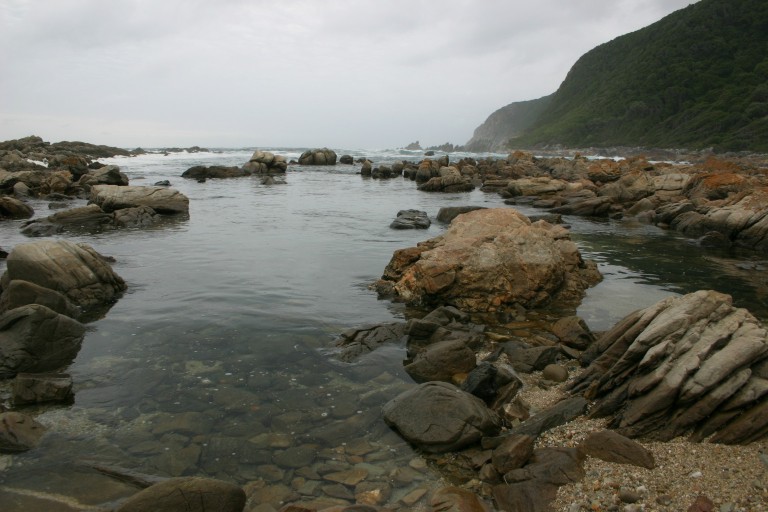
Unlike inland Drakensberg or Cederberg routes, the Otter is a coastal traverse — cliff paths, forest gorges, tidal pools and river mouths that can hold the whole cohort after rain. It's not technical mountaineering, but Day 4 (~13.8 km) is a genuine crux over five consecutive days.
What our group learned on trail
Day 4 is the crux — we started before sunrise and still finished late after a river hold. River waits are real — build zero tight deadlines on Day 5 and brief your shuttle driver. Split cooking rotation by hut night; pre-mix dehydrated meals at home.
Training plan (8 weeks out)
Train for back-to-back 12–14 km days with a loaded pack, not a single Saturday hike. Add stairs or incline if you live somewhere flat; practice descents — Otter punishes knees on rocky drops to river mouths. Details: difficulty guide.
Standard 5-Day Itinerary
SANParks assigns fixed hut nights. The classic west-to-east sequence:
| Day | Hut | Approx. distance | Notes |
|---|---|---|---|
| 1 | Ngubu Hut | ~4.8 km | Short warm-up from Storms River; afternoon at camp |
| 2 | Scott Hut | ~7.9 km | More coastal contouring; river checks |
| 3 | Oakhurst Hut | ~8.6 km | Steady middle day; forest and cliff mix |
| 4 | Andre Hut | ~13.8 km | Longest day — start early, manage heat and pace |
| 5 | Nature's Valley | ~6.8 km | Final push to the finish; celebrate at the beach |
Distances are from SANParks' published route description. Treat them as planning figures — your pace, photo stops and river waits add time.
River crossings — the schedule wildcard
The Otter is waymarked — you will not get lost for days. Rivers are what blow up itineraries. After rain in the catchment, coastal mouths run fast and brown; SANParks may hold the entire cohort at the bank until rangers judge flow safe.
Rivers by stage (planning view)
| Stage | River / mouth pressure | What we saw |
|---|---|---|
| Days 1–2 | Smaller mouths after Ngubu and Scott | Usually straightforward in dry weather — still check with rangers each morning |
| Day 3 | Oakhurst approach streams | Middle-day rain two days earlier can raise levels here |
| Day 4 | Bloukrans River and other mouths on the long stage | Main crux — SANParks treats Bloukrans as the most serious crossing; holds here pushed our Andre Hut arrival past sunset |
| Day 5 | Final mouths before Nature's Valley | Less distance, but fatigue + wet rock still demand patience |
Bloukrans is the name every Otter veteran mentions — not because the whole trail is a swim, but because one bad crossing decision on Day 4 has real consequences. Treat ranger instructions as law, not suggestions.
Hold protocol (what actually happens)
- Morning check-in — ask hut wardens or rangers about crossing status before you leave camp
- Arrive at the mouth as a group — do not split up or cross ahead of the cohort
- If water is high — queue on the bank; rangers assess depth and flow (we waited until mid-morning once after rain two days earlier)
- When cleared — cross together, poles out, pack straps loose, shoes you accept getting soaked
- If held overnight — rare, but possible in flood conditions; follow warden instructions and adjust shuttle plans
Gear that matters: camp sandals or wet shoes, dry bags for socks and sleep clothes, trekking poles for slippery boulders. Full footwear strategy: packing list and navigation guide.
River crossings and hold protocol (quick rules)
Several days involve crossing rivers at the coast. After rain, this becomes the main schedule risk — not fitness.
Rules of thumb:
- Never cross alone if water is high or moving fast
- Wait for ranger guidance when SANParks flags a crossing as closed — groups queue at the bank
- Hold protocol: If water is up, rangers may delay the whole cohort until levels drop; we waited until mid-morning once after rain two days earlier
- Pack shoes you're happy to get wet, or use a dry-bag strategy for camp shoes
- On Day 4, a hold can push your finish past sunset — tell your shuttle driver to expect late contact
Full crossing notes and day-by-day timing sit in the itinerary and difficulty guides.
Getting There and Transport
Storms River Mouth is ~2 hours from Port Elizabeth or ~2.5 hours from George — most groups overnight nearby before Day 0 registration. Nature's Valley has limited services; pre-arrange a shuttle back to Storms River and tell the driver Day 5 may run late after river holds.
Shuttle bands, airport routing and two-car strategies: getting-there guide.
Best Time to Hike
| Season | Pros | Cons |
|---|---|---|
| Feb–May | Warm, long days, popular "classic" window | Book early; Easter demand |
| Sep–Nov | Spring light, fewer crowds than peak summer | Wind on exposed cliffs |
| Jun–Aug | Quieter | Cold fronts, rain, higher river risk |
Avoid planning tight international flights immediately after Day 5 in winter — weather delays happen. Confirm age 12–65 and medical paperwork on the official Otter page before inviting first-time multi-day hikers.
FAQ (official sources)
Common questions
Frequently asked questions
Straight answers on fit, features, and buying — open a question to read more.
SANParks enforces a minimum age of 12 and maximum age of 65 for Otter Trail participants. IDs are checked at Storms River Mouth registration. Minors typically need an adult in the group — verify current guardian rules on the official Otter page before you book.
Yes. SANParks requires every Otter Trail hiker to complete the official Medical Questionnaire Examination Certificate, signed and stamped by a registered doctor, and hand it in at Storms River Mouth reception on arrival — together with the park's disclaimer / indemnity form. Forms are typically only accepted if issued within 30 days of your start date; confirm the current rule on the SANParks Otter Trail page before your appointment. Without the certificate you will not be allowed on the trail.
Bloukrans River on Day 4 is the crossing SANParks treats most seriously — it sits on the longest stage (~13.8 km) and can hold groups for hours after rain in the catchment. Smaller mouths on Days 2–3 and Day 5 still close in bad weather, but Bloukrans is the one that blows up shuttle timing. See the navigation guide for crossing protocol.
Fitness and Experience Level
The Otter suits hikers who:
- Are comfortable walking 6–8 hours on consecutive days
- Have trained with a loaded pack (even if not heavy)
- Understand basic multi-day hygiene and blister prevention
It is not ideal as a first-ever overnight hike unless your group is experienced and patient. Day 4's distance catches people who only trained for flat day hikes. See the difficulty guide for a honest fitness breakdown.
Packing and budget (quick pointers)
Use the Packing List Builder and packing guide for the full checklist. Priorities: 40–55 L pack, broken-in trail shoes, coastal layers, dry bags for river crossings, headlamp for Day 4.
ZAR bands and shuttle maths: cost guide and Trek Cost Calculator.
Otter Trail vs Other South African Multi-Day Hikes
| Otter Trail | Giants Cup | Cederberg | |
|---|---|---|---|
| Landscape | Coastal cliffs & forest | Drakensberg grasslands | Sandstone wilderness |
| Nights | SANParks huts | Ezemvelo huts | Wild camping |
| Distance | ~42 km | ~60 km | Flexible (~35 km typical) |
| Booking | Very competitive | Moderate demand | Permit + self-planned |
| Best for | Ocean lovers, bucket list | Alpine hills, hut rhythm | Scrambles, solitude |
Slot guides — go deeper
This planning guide is the single entry point for Otter. When you need depth, use the slot guides — they repeat nothing essential from this page:
| Slot | Guide |
|---|---|
| Itinerary | Day-by-day stages |
| Accommodation | SANParks huts |
| Cost | ZAR budget |
| Packing | Gear list |
| Getting there | Storms River & Nature's Valley |
| Difficulty | Fitness & Day 4 crux |
| Food | Self-catered menus |
| Navigation | Waymarks & maps |
Safety Notes
Tell someone your SANParks dates and shuttle plan. Secure food from baboons, carry a whistle and basic first aid, and do not rely on patchy cell signal for navigation — see the navigation guide. In an emergency, hut wardens and SANParks radio protocols apply.
Common questions
Frequently asked questions
Straight answers on fit, features, and buying — open a question to read more.
No. This planning guide is the only route overview on HikingWithLee — there is no second otter-trail-complete-guide slug. Use the slot guides above for cost, food, navigation and hut detail.
As early as the reservation window allows — often many months ahead. Monitor the 2027 booking calendar and book the moment your target season opens.
No. SANParks assigns the standard west-to-east sequence: Ngubu → Scott → Oakhurst → Andre, then finish at Nature's Valley on Day 5.
Wait for ranger clearance. Groups queue until water levels are safe — build no tight deadlines on Day 4 and Day 5, and tell your shuttle driver you may finish late.
Planning depth (expand here, not a second complete guide)
This page is the single Otter hub — same quality bar as Alta Via 1 complete guide, but without a duplicate *-complete-guide slug. Drill into satellites when you need stage timing, ZAR line items or river-crossing detail:
| Topic | Guide |
|---|---|
| Stage timing | Itinerary |
| SANParks fees & food budget | Cost guide |
| Hut mattresses & kitchens | Accommodation |
| River crossing protocol | Navigation |
| Self-catered food | Food guide |
Compare: Giants Cup · Boesmanskloof · Trek Comparison
Watch the hike
Otter Trail film on YouTube — five days of Tsitsikamma coast with friends. Pair it with the itinerary when you want stage-by-stage timing.
Compare routes: Trek Comparison · South Africa hub · 2027 booking calendar