
GR20 Corsica — Complete Planning Guide
Full researched planning guide for Corsica’s GR20 — stages, refuges, camping, transport, costs, heat/water, gear and safety. Not hiked first-hand; compare with TMB and Alta Via 1.
Last verified
The GR20 is Corsica’s legendary long-distance trail — often called Europe’s hardest classic thru-hike. Roughly 180 km of granite ridges, fixed chains, steep gullies and Mediterranean heat, typically walked in 12–16 days north→south (Calenzana → Conca) or the reverse.
This is a full researched planning guide: stage structure, PNRC refuges, camping rules, transport, budget bands, water/heat tactics and kit. It is not trail beta from Lee.
Quick links: Trek hub · European bucket-list treks · TMB guide · AV1 guide · France hub · Trek Finder · Packing List Builder · Trek Cost Calculator
Quick facts
| Island | Corsica, France |
| Classic direction | Calenzana (NW) → Conca (SE) |
| Distance | ~180 km (variants + stage combines change totals) |
| Duration | 12–16 days typical; some stretch to 18 |
| Style | PNRC refuges + tent/bivouac mix |
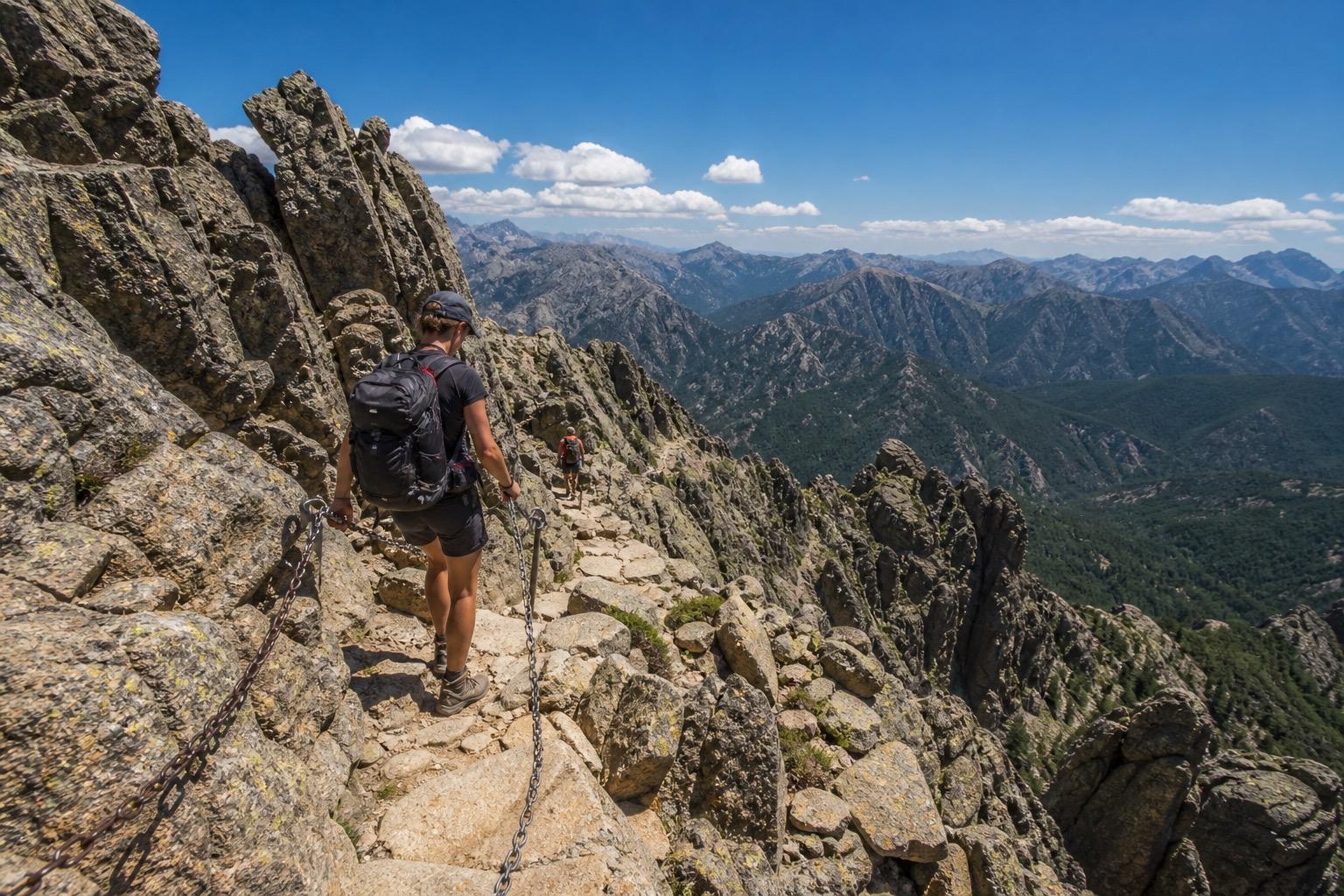
| Difficulty | Very hard — scrambling, chains, sustained steepness |
| Terrain | Granite ridges, slabs, gullies; not a “hut stroll” |
| Best months | June – September (July–August = heat + crowds) |
| Currency | EUR |
| Lee’s status | Bucket list — not hiked |
Route overview
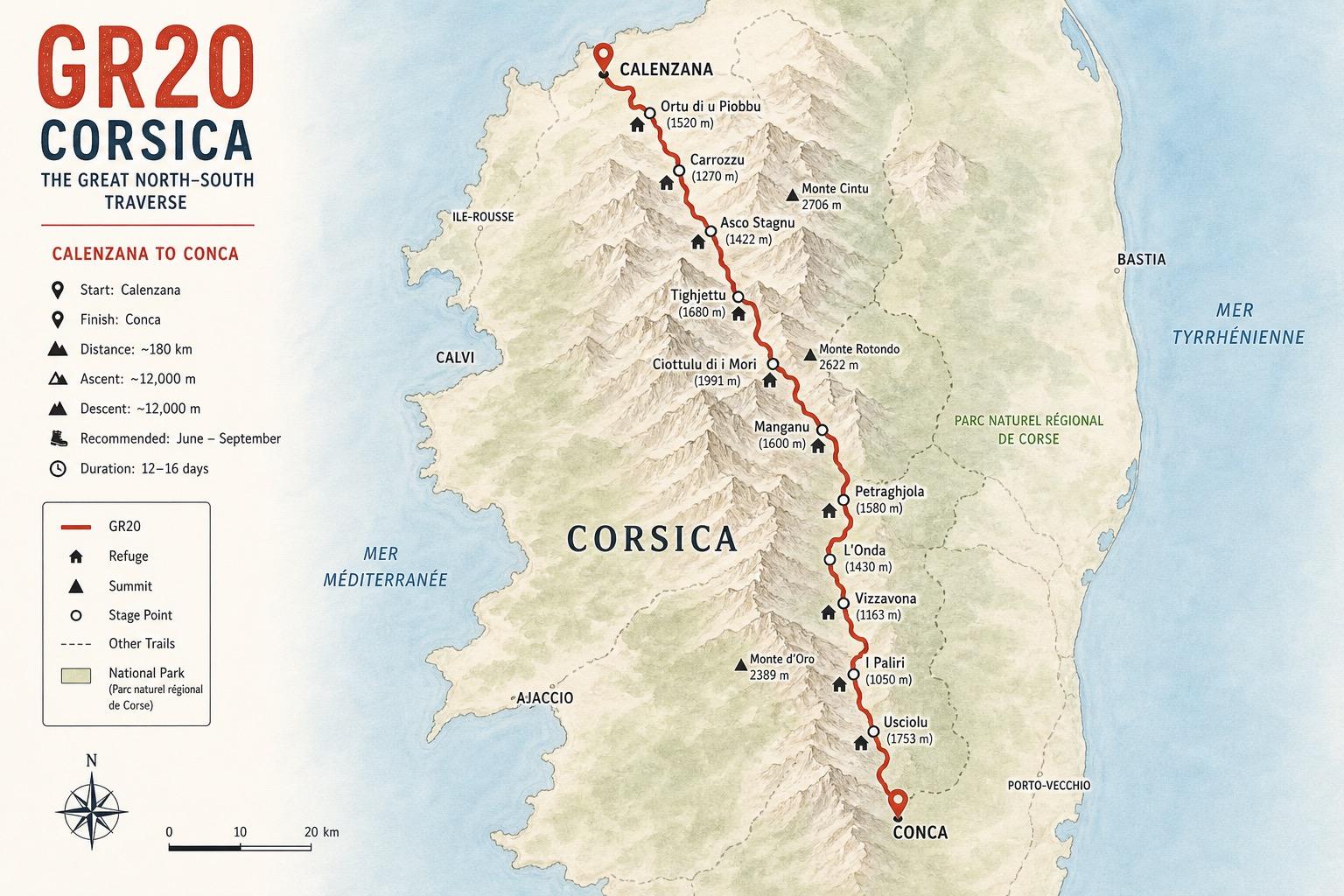
The GR20 follows the mountainous spine of Corsica. Research and guidebooks usually split it at Vizzavona (roughly the midpoint, with road/rail access):
| Section | Character |
|---|---|
| North (Calenzana → Vizzavona) | Often rated the more technical half — ridges, chains, exposed granite |
| South (Vizzavona → Conca) | Still tough and long, typically slightly less continuous scrambling, more forest/ridge mix |
Many hikers only walk one half. Doing the full island is an achievement because of cumulative physical load, not because every kilometre is via-ferrata hard.
Classic stage / itinerary framework
Traditional guidebooks describe ~16 stages; most fit hikers combine stages into 12–14 days. Below is a day-band framework — not a locked booking plan. Direction here is the classic north → south.
North — Calenzana → Vizzavona
| Day band | Typical overnight zone | Terrain / effort | Focus |
|---|---|---|---|
| 1–2 | Ortu di u Piobbu / Carozzu corridor | Immediate steep climb; hands early | First refuge nights; don’t over-combine yet |
| 3–4 | Ascu-Stagnu / Vaccaghja | High ridge work; weather-sensitive | Chains / slabs; start at dawn in heat |
| 5–6 | Ciottulu di i Mori / Manganu | Long technical days | Water planning critical |
| 7 | Petra Piana / Onda → Vizzavona | Midpoint access | Resupply, shower, optional rest night |
South — Vizzavona → Conca
| Day band | Typical overnight zone | Terrain / effort | Focus |
|---|---|---|---|
| 8–9 | Capannelle / Prati | Ridge + forest mix | Still big days — south is not a cooldown lap |
| 10–11 | Usciolu / Asinau | Remote feel; heat on south aspects | Protect water and skin |
| 12–13+ | Paliri → Conca | Final coastal push | Taxi/bus onward to Porto-Vecchio |
North-only or south-only options
| Choice | Why people pick it | Logistics note |
|---|---|---|
| North only | More technical “GR20 character” | Exit via Vizzavona rail / road |
| South only | Slightly less continuous scrambling for many | Start mid-island; still hard and hot |
| Full traverse | Island-spine achievement | Needs the most food/refuge planning |
Getting there / transport
Airports & ferries
- Bastia (BIA), Ajaccio (AJA), Figari (FSC) and Calvi (CLY) are the usual gateways
- Ferries from mainland France / Italy to Bastia, Ajaccio, Île-Rousse, etc.
- For a classic north→south thru-hike, research typically points to arriving near Calvi / Calenzana and exiting near Porto-Vecchio / Figari after Conca
Trailheads
- Start (N→S): bus / taxi from Calvi to Calenzana
- Finish: Conca has limited services — plan onward taxi/bus to Porto-Vecchio
- Midpoint bail-out: Vizzavona sits on the Ajaccio–Bastia railway — useful for half-treks or emergencies
Book island transport early in July–August; car hire and taxis tighten up in peak season.
Accommodation & how to book
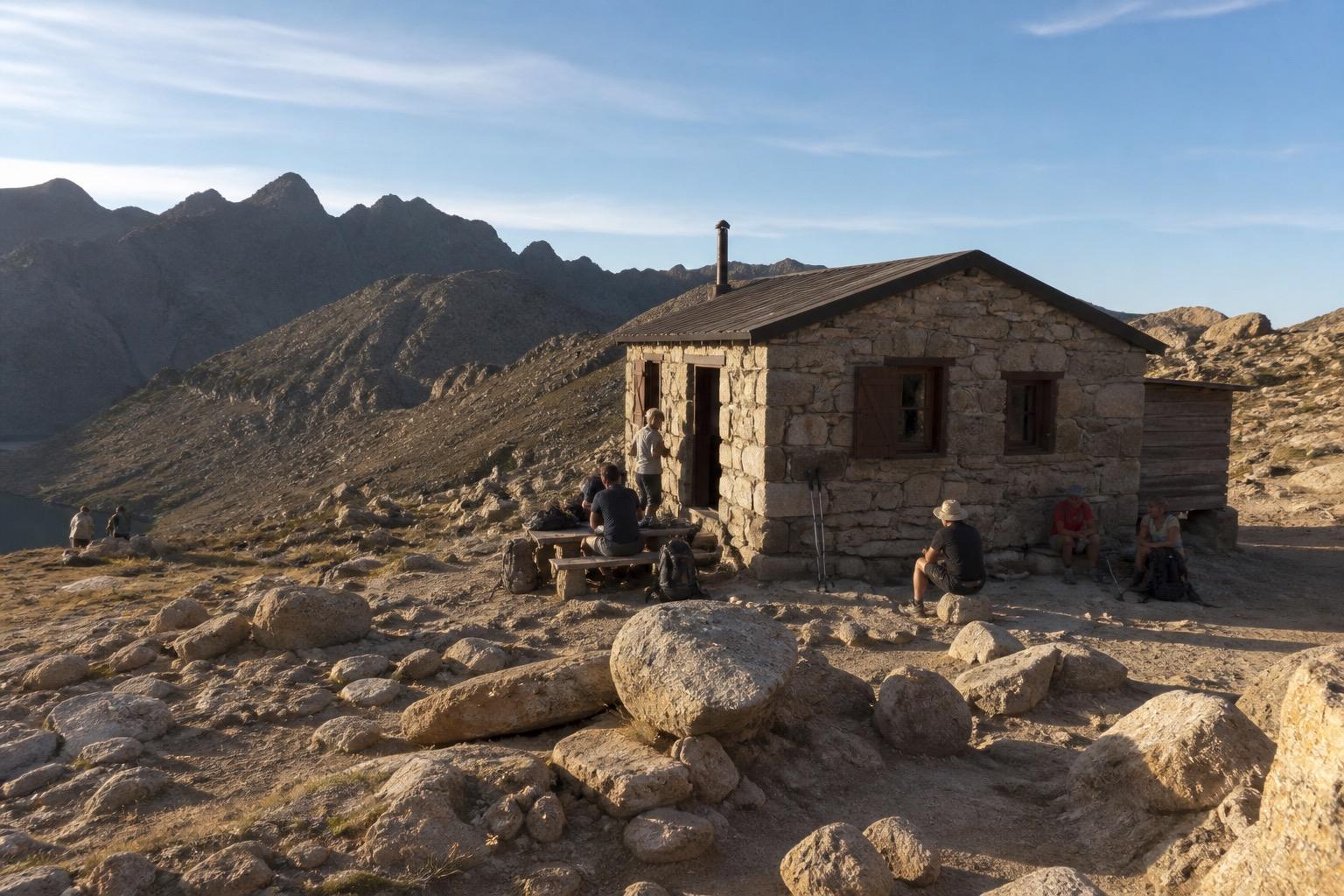
GR20 overnight culture is not Dolomites half-board luxury.
| Option | What to expect | Booking (research) |
|---|---|---|
| PNRC refuges | Basic dorms, meals often available, busy in peak | Book via park / refuge systems early for July–August |
| Bergerie / private stops | Some stages offer alternatives | Confirm season by season |
| Camping / bivouac | Common near refuges in designated areas | Follow park rules — wild camping restrictions apply |
| Hotels | Calenzana, Vizzavona area, Conca/Porto-Vecchio ends | Book ends + optional rest night at midpoint |
Booking windows & practicalities
- Peak season: research suggests locking key refuge nights months ahead
- Carry a sleeping bag / quilt even if you book dorms — refuge blankets vary
- Bring a liner, earplugs and a stove plan if you expect mixed camping nights
- Many hikers resupply at Vizzavona (and limited shops elsewhere) — don’t assume Alpine-style hut meals every night
Unlike AV1 rifugi, you should plan for more self-reliance: heavier food carry, more camping logistics, fewer “show up and get served” evenings.
Costs / budget ranges
Estimates only (EUR, researched bands — not Lee’s spend). Model your style in the Trek Cost Calculator.
| Category | Typical range (estimate) | Notes |
|---|---|---|
| Refuge half-board | €45–75 / night | Varies by refuge and season |
| Refuge dorm only | €15–30 / night | Meals extra |
| Camping near refuge | €5–15 / night | Where permitted |
| Food / gas / snacks | €15–35 / day | Heavier if self-catering |
| Island transfers | €40–150+ | Airport–trailhead taxis add up |
| 14-day mid budget | ~€900–1,800 pp | Excl. flights to Corsica; style-dependent |
Flights/ferries to Corsica in August can dominate the trip cost — book early.
When to go + weather / hazards
| Window | Research notes |
|---|---|
| June | Longer days, fewer crowds than August; some snow possible on highest northern sections early |
| July–August | Hottest, busiest, fullest refuges; start hiking at dawn |
| September | Often excellent — cooler, quieter; watch early autumn storms |
| Outside Jun–Sep | Not the standard hiking window for most visitors |
Primary hazards: heat exhaustion, dehydration, thunderstorms on ridges, slippery granite when wet, overcrowding on chains, and underestimating pack weight on technical ground.
Difficulty & fitness
Honest framing vs Lee’s first-hand Alps weeks:
- Harder underfoot than TMB — more hands, more slabs, more stop-start scrambling
- Less “comfortable hut rhythm” than AV1
- Fitness needs: strong legs, grip strength, comfort with exposure, heat tolerance, and the ability to move carefully when tired
Train on rocky, steep terrain with a loaded pack. Stair-machine fitness alone is not enough.
Equipment / packing
Build the list in the Packing List Builder. Research-backed essentials:
- Approach shoes or light boots with sticky rubber — many prefer lighter footwear for granite; broken-in is non-negotiable
- Gloves for chains / hot rock
- Sun armour: hat, sleeves, high-SPF sunscreen, sunglasses
- Water system: bottles + soft flasks, electrolyte tabs, filter/treatment
- Shelter: tent or bivy if camping; check current park rules
- Sleep system: bag rated for cool mountain nights even in summer
- Stove + food for self-cater stretches
- First aid with serious blister capacity
- Poles (helpful on descents; stow on technical ridges)
You typically carry more than on a pure Dolomites half-board trek. Ruthlessly cut luxury weight.
Navigation & safety
- Waymarked as a GR, but fog and granite can erase confidence fast — offline GPX + paper map
- Start early every hot day; aim to clear exposed ridges before afternoon storms
- Know when to wait out wet rock — granite slabs become polish
- Share your itinerary; rescue is possible but not instant on remote stages
- Travel insurance covering helicopter evacuation in France is essential
- If chains feel beyond your comfort on day 2, reconsider continuing the north — pride is a poor navigator
Compare with Lee’s first-hand treks
| Trek | Lee hiked? | Terrain character | Overnight style |
|---|---|---|---|
| GR20 | No | Hands, heat, heavy pack | Refuge + camping mix |
| TMB | Yes — guide | Long cols, hut comfort | Huts + hotels |
| AV1 | Yes — guide | Dolomite rock, rifugio rhythm | Rifugio half-board |
| Bernina | Yes — guide | Long Swiss days, quieter | SAC-style huts |
Bottom line: GR20 is the “full-body Corsica exam.” Alps hut experience helps, but it is not the same sport.
Official resources
- Parc naturel régional de Corse
- France tourism
- Corsica bus / regional transport info (verify current timetables)
- IGN maps / outdoor platforms for offline GPX (cross-check against official park notices)
Next steps
- Decide full traverse vs north or south half
- Pick a 14–16 day first draft (compress later if you earn it)
- Book refuges / camping strategy and island flights early for peak months
- Model budget in the Trek Cost Calculator
- Build a ruthless kit list in the Packing List Builder
- Re-read TMB and AV1 only as fitness baselines, not as GR20 substitutes
When Lee hikes it, this becomes a first-hand cluster. Until then — plan for heat, granite and honesty about pack weight.
Related guides
trek comparison
Alta Via 1 vs Tour du Mont Blanc: Which Hut Trek Should You Hike?
Alta Via 1 · 8 min read
Read guide →
bucket list guide
Walker’s Haute Route — Complete Planning Guide
Walker’s Haute Route · 10 min read
Read guide →
trek cost guide
Tour du Mont Blanc Cost Guide: What We Actually Spent
Tour du Mont Blanc · 8 min read
Read guide →